%20Cover.avif)
Making of a Portrait
I have kept journals for decades, and for most of that time I misunderstood what they were. Dates, marks, fragments of scripts I could not read, pages of punctuation that meant nothing to anyone else — I thought of it as storage, somewhere to put a thought so it would stop circling. What accumulated was not a record. It was a structure: the same preoccupations returning in different handwriting, year after year, until the shape of them was unmistakable. A portrait had been assembling itself the whole time. What it lacked was a way to be seen at once.
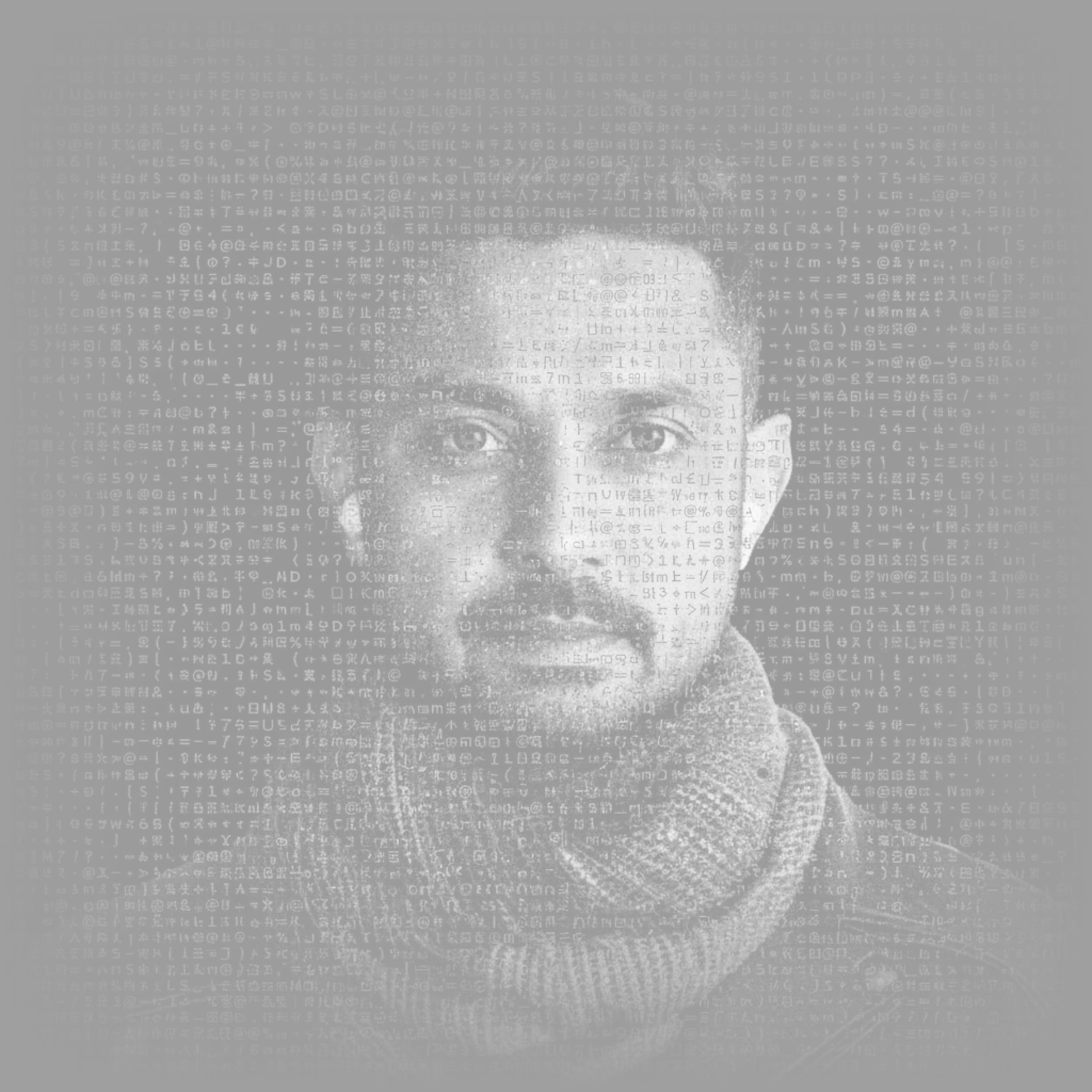
A photograph gives you a likeness, and a likeness is the least informative thing about a face. It fixes one sixtieth of a second and discards everything that produced it. What a person is actually made of — what they keep, how they order it, what they have not built yet — leaves no surface for a camera to find. That is the problem this piece takes on: not how to depict someone, but how to show the structure underneath the depiction.
Mane Tatulyan's notebooks gave that structure its names. Memory, reason, imagination — what I carry, what I arrange, and what I have yet to make. It is a way of sorting a self that holds up under use, which is rare for a framework. The notebooks are also the physical object: dotted pages that travel with me, and where every sketch behind this piece was drawn.
I look up to Patrik Hübner as a generative artist, and this portrait is generative art. His work made the case that data can be the material itself rather than the thing being illustrated, and that supplied the mechanism. The photograph is never displayed — it is read. A luminance value for every cell in a 140-square grid, and that value decides which character, from which writing system, lands there. Light does the drawing.
A portrait as memory, reason and imagination, fused. Three plates on a diagonal — past, present, future — that resolve only where they overlap, because a face is a sequence rather than a moment. An earlier version of that line read "a portrait is the architecture of self." I struck it out: it explained where it needed to claim.
Identity without craft stays private; craft without identity is decoration. The decades of journals are why this has something to be about, and the years of practice are why it could be built at all. That is also where taste comes from — not from knowing more, but from having accumulated enough of your own material to recognize what is worth making. The notebooks were the practice. The portrait is what the practice was for.
TERMS OF USE
AMIT PATEL DESIGN𝔖®, CURIOU𝔖 𝔖PACE®, and MEDU𝔖A™ word marks and design marks, along with other names, logos, graphics, and materials displayed on the Site that function as trademarks (collectively, the "Marks"), are owned by or licensed to AMIT PATEL DESIGN𝔖® INℭ. These Marks are protected by copyright, trademark rights, and other intellectual property rights under United 𝔖tates and international law. Unauthorized use, reproduction, or distribution of these Marks is strictly prohibited.
Content on this site may not be used, reproduced, or otherwise exploited for purposes of training or developing artificial intelligence or machine learning technologies, nor for data mining, scraping, or crawling.